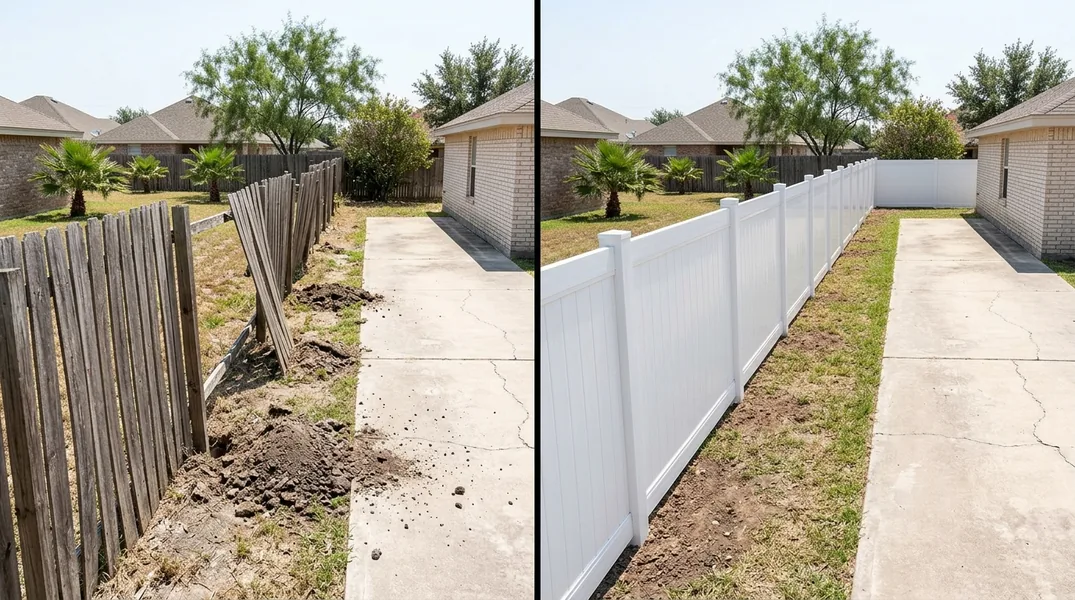
Understanding McAllen's Soil: Delta Clay and Caliche
If you're planning a fence project in McAllen, understanding your local soil composition is essential to your fence's long-term success. The Rio Grande Valley, where McAllen is located, sits on a foundation of Delta clay and caliche that presents both challenges and opportunities for fence installation. Delta clay is a heavy, moisture-sensitive soil that expands when wet and contracts when dry, creating significant movement throughout the year. Caliche, a naturally cemented layer of calcium carbonate, lies beneath the clay and can complicate digging, drainage, and post foundation work.
Homeowners often notice fence posts leaning or shifting after just a few months or years, and the culprit is rarely poor installation. Instead, it's the soil itself that's at work. When heavy rains saturate the Delta clay, it swells upward, pushing fence posts out of plumb. During dry seasons, the soil shrinks, creating voids around the post base and leaving it unsupported. This cycle of expansion and contraction, repeated year after year, is why so many McAllen residents see their fences gradually tilt or settle unevenly. Professional fence contractors in the region understand this dynamic and design their installations to account for it.
Why Fence Posts Lean in McAllen's Climate
Fence post failure in McAllen is not a mystery once you understand the interplay between soil composition and the subtropical climate. The region experiences intense summer heat and humidity, followed by seasonal dry periods and occasional heavy rainfall. During the wet season, Delta clay absorbs moisture and expands, often pushing fence posts upward and outward. This heaving effect can shift a post several inches out of vertical alignment. Conversely, during drought conditions, the soil dries and shrinks, leaving the post sitting in a loosened hole with inadequate lateral support. The freeze-thaw cycles common in northern climates don't occur here, but the wet-dry cycling is just as destructive.
Another critical factor is the caliche layer beneath the surface clay. When a fence contractor encounters caliche during digging, they face a choice: break through it at significant labor cost, or set the post above it. Posts set in clay alone, without reaching stable caliche or a proper concrete footer below the clay's active zone, are far more prone to movement. This is why professional Wood & Privacy Fence Installation in the region requires deeper post holes and often reinforced concrete footings that extend below the clay's seasonal movement zone. A post set 24 inches deep might work fine in northern soil, but in McAllen, 36 to 48 inches is often necessary to achieve stability.
Proper Post Installation Techniques for McAllen Soil
Experienced fence contractors serving McAllen have developed proven methods to combat soil movement and keep fence posts standing firm. The most effective approach begins with digging deep enough to bypass the most active clay layer, ideally reaching into more stable soil or setting a concrete footer that extends well below seasonal moisture fluctuations. Many professionals recommend post holes at least 36 to 42 inches deep for residential fencing, with concrete footings that are properly sized and cured. The concrete should extend below the frost line (though minimal in our region) and well into stable soil layers.
Beyond depth, the type of concrete and its installation method matter significantly. Standard concrete mixed on-site and poured into the hole is acceptable, but some contractors use pre-mixed concrete bags or specialized concrete products designed for the region's soil conditions. Proper concrete curing is also essential; rushing this step means the concrete won't achieve full strength before the post is subjected to soil movement. Additionally, drainage around the post footer should be considered. If water pools around the base of the post, it accelerates clay saturation and heaving. Some installers slope the ground slightly away from the post or use gravel to improve drainage. For Vinyl & PVC Fence Installation and other materials, similar principles apply, though the flexibility of some materials can accommodate minor movement better than rigid wood.
Do I Need a Permit for a Fence in McAllen?
Before you start any fence project, understanding local regulations is crucial. In McAllen, fence permits are typically required for residential installations, and the specific requirements depend on fence height, type, and location on your property. The City of McAllen's building department oversees fence permitting, and most contractors will handle this process for you. Permits exist to ensure that fences comply with property line setbacks, don't obstruct sight lines at intersections, and meet structural standards. Skipping the permit process might seem like a cost-saving measure, but it can lead to costly removal orders or complications when you sell your home.
Permit requirements generally apply to fences over a certain height (usually 4 to 6 feet, depending on location) and to any fence in a front yard setback area. Corner lots and properties near public rights-of-way have stricter regulations. If your property is in an HOA community, you'll need HOA approval before even applying for a city permit, and HOA standards are often more restrictive than municipal code. When you contact McAllen Fence Contractors at (956) 586-5811 for a free estimate, our team will discuss permit requirements and help navigate the approval process as part of your project planning.
Fence Height Regulations and HOA Approved Fence Standards
Fence height regulations in McAllen vary by zone and location on your property. Typically, front yard fences are limited to 4 feet in height, while backyard fences can reach 6 feet or taller in some residential zones. However, these are general guidelines, and your specific property may have different restrictions based on zoning, lot size, and proximity to major intersections. The rationale behind height limits in front yards is sight line safety; a fence that's too tall can obstruct drivers' views and create hazardous conditions at driveways and street corners. Backyard fences have fewer restrictions because they don't affect public visibility.
If you live in an HOA community, you're likely subject to additional restrictions that supersede or supplement municipal code. Many HOA communities require pre-approval for any fence project and specify approved materials, colors, and styles. An HOA approved fence might mean vinyl in white or tan, or wood in a specific stain color. Some HOAs prohibit chain link entirely, while others require aluminum or ornamental iron for front-facing applications. Before you invest time and money in a fence design, review your HOA CC&Rs (Covenants, Conditions, and Restrictions) or contact your HOA board directly. Our team at McAllen Fence Contractors can help you understand these requirements and design a fence that meets both municipal and HOA standards. Call us at (956) 586-5811 to discuss your specific situation and get started on a compliant project.
Fence Permit Cost and Installation Budget in McAllen
Understanding the full cost of a fence project means accounting for permits, materials, labor, and site-specific challenges like soil conditions. Permit costs in McAllen are typically modest, usually ranging from $50 to $200 depending on the project scope and the city's fee structure at the time of application. However, permit costs are only a small fraction of your total fence project budget. The real expense comes from materials and labor, and this varies significantly based on fence type, length, and local soil conditions. Wood & Privacy Fence Installation costs differ from Chain Link Fence Installation, which in turn differs from Aluminum & Ornamental Iron Fencing. Regional pricing reflects local labor rates, material availability, and the specific challenges of installing in Delta clay and caliche soil.
In McAllen, you should expect to budget more for post installation than you might in other regions because of soil conditions. Deeper holes, more concrete, and potentially caliche removal add to labor time and material costs. When you request a free estimate from McAllen Fence Contractors, we'll provide a detailed breakdown that accounts for these regional factors. Our estimates include permit costs, materials, labor, and any site-specific challenges discovered during the initial assessment. This transparency helps you make an informed decision and ensures there are no surprises when the project begins. Contact us at (956) 586-5811 to schedule your consultation and receive a comprehensive project quote.
Looking for a professional tree service in McAllen? McAllen Fence Contractors responds fast for all your fence needs.
Get a Free Quote