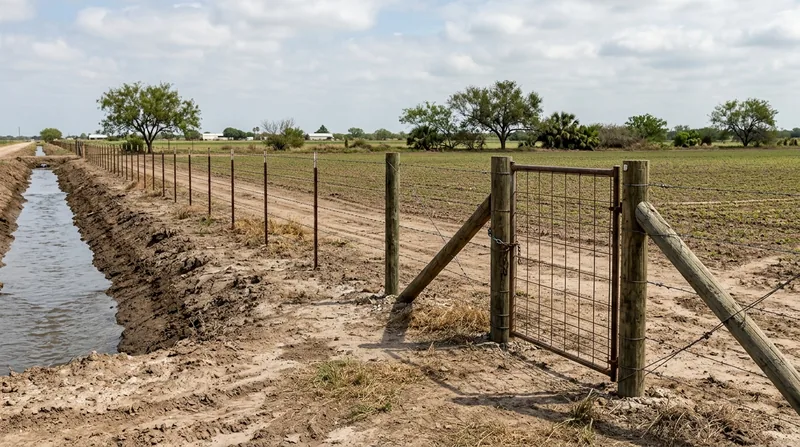




Farm fence installation in McAllen crosses flat delta land irrigated by canals that run through Hidalgo County, and every post must be set deep in clay and caliche to hold through the wet-dry cycles that heave ordinary installations. Ranch fencing here is not decorative: it contains livestock, marks property lines across working acreage, and withstands the wind and moisture that define the Lower Rio Grande Valley. We install T-post and wire, wood rail, pipe, and split rail fencing built to last through drought, flood, and the seasonal storms that sweep the region from June through November. Since 2010, we have set posts and strung wire on ranches, farms, and acreage properties across McAllen, Pharr, Mission, Edinburg, and the surrounding communities, working with the land and the soil as it is, not as we wish it to be.
Why Ranch Fencing Matters in McAllen and Hidalgo County
The Rio Grande Valley floor is flat and productive, crossed by irrigation canals and drainage systems that shape every property line. Soil here is delta clay mixed with caliche, which expands when wet and shrinks when dry, heaving posts that are not set deep enough or not set in concrete at all. Wind from Gulf storms and the steady humidity of the coast work together to rot untreated wood at the ground line, and rust corrodes bare steel within months. Ranch fencing must do real work: contain horses and cattle, mark boundaries across open acreage, and survive the seasonal extremes that test every installation.
- T-post and wire fencing holds livestock on pasture and costs less per linear foot than rail or pipe, making it the standard for large acreage.
- Wood rail fencing, including split rail fence installation, adds character to ranch entrances and horse properties while providing a sturdy, visible boundary.
- Pipe fence installation creates a durable, low-maintenance perimeter that resists rot and rust when properly galvanized and set in concrete.
- No climb horse fence combines wire mesh with board or rail framing to prevent hooves from catching and injuries from occurring.
- Barbed wire fence installation remains the most economical choice for large pastures and working ranches where livestock containment is the only goal.
- Deep post setting in concrete, not tamped soil alone, is the single most important factor in holding a fence line through clay heave and wind.
Every ranch fence we install begins with a walk of the property line and a conversation about what the fence must do and what the budget allows.
Key info: Hidalgo County and the City of McAllen set fence height, setback, and material rules that vary by zoning and lot size. Ranches on unincorporated land answer to county code, while properties inside city limits answer to city ordinance. Always verify local requirements with the McAllen Planning Department or your county commissioner before ordering materials. Deed restrictions and HOA covenants on some properties add further limits.
For more on what we can do on your acreage, see our fence repair and maintenance services as well.
How We Install Ranch Fencing in McAllen: From Survey to Set
Ranch fencing starts with knowing where the line is and what the soil will do. We work from your existing survey or the line you identify, then dig post holes to the depth required by the soil type and the fence load. Delta clay demands deeper posts than sandy soil, and posts set in concrete hold far longer than posts tamped in soil alone. We space posts according to the fencing method: T-post wire runs on 6- to 8-foot centers, wood rail on 8- to 10-foot centers, and pipe on 10- to 12-foot centers. Every post is plumb, and every horizontal element is level or racked to follow the land without gaps at the base.
- We locate all utilities using Texas 811 before any hole is dug, confirming that no water, gas, or electric line lies in the post path.
- Post holes are dug to depth required by soil bearing capacity and frost line, typically 30 to 48 inches in this region depending on soil type.
- Posts are set in concrete mixed to the strength required by local code and allowed to cure before any load is applied to the fence.
- Wire is pulled tight using a come-along or power stretcher, and all hardware is galvanized or stainless to resist rust in the coastal humidity.
- Rails are attached with galvanized bolts or lag screws, never nails, so the connection holds through wind and livestock pressure.
- The finished fence is inspected for plumb, level, proper tension, and secure fastening before we leave the property.
On a typical ranch property in McAllen, we can install 500 to 800 linear feet of pipe or rail fencing in a day, depending on soil conditions and the distance between posts.
Local example: A 40-acre ranch in Hidalgo requires 1,200 linear feet of perimeter fencing. We locate the property line using the owner's survey, call 811 to clear utilities, and dig 150 post holes at 8-foot intervals to a depth of 40 inches in the clay. Posts are set in concrete and allowed to cure overnight. The next day we hang rails and attach wire, pulling everything tight and level. The job takes two days and yields a fence that will hold livestock and weather for 15 to 20 years with no major maintenance.
For detailed information on our other fencing methods and materials, visit our pages on wood and privacy fence installation and chain link fence installation.
Ranch Fencing Methods: Which Approach Fits Your Land
| Method | Description | Best For |
|---|---|---|
| T-Post and Wire | Steel T-posts driven or set in holes, strung with high-tensile or barbed wire pulled tight and stapled or clipped. | Large pastures, cattle ranches, working land where cost per foot is the priority and appearance is secondary. |
| Split Rail and Wood | Pressure-treated or cedar posts with 2x6 or 2x8 rails mortised and bolted, creating a classic ranch look with strength. | Horse properties, ranch entrances, visible boundaries where appearance and durability matter equally. |
| Pipe Fencing | 2-inch or 2.5-inch galvanized steel pipe bolted to posts, creating a smooth, strong perimeter that resists all weather. | High-value properties, horse ranches, areas where durability and minimal maintenance are essential over 25+ years. |
| No-Climb Horse Fence | Wood frame with welded wire mesh that prevents hooves from catching, combining safety with visibility and strength. | Horse pastures, equestrian properties, any acreage where livestock safety and injury prevention are paramount. |
Farm and Ranch Fencing Cost in McAllen: What to Expect
Ranch fence installation costs depend on the method, the soil, the distance from your property to our shop, and whether posts must be set in concrete or can be driven. T-post and wire fencing starts at around $11 per linear foot for basic pasture work on easily dug land. Wood rail and split rail fencing begins higher, typically $18 to $28 per linear foot, because each post must be set in concrete and each rail must be cut, fitted, and bolted by hand. Pipe fencing runs $20 to $35 per linear foot depending on pipe diameter and the quality of the galvanizing. No-climb horse fence, which combines frame and mesh, ranges from $22 to $32 per linear foot. Every estimate accounts for the actual soil conditions on your property, the distance from utility lines, and the slope or terrain that may require racking or stepped installation.
The best way to know your actual cost is to have us walk the property and measure the line. We provide a free estimate within 24 hours, and we recommend getting two or three estimates so you can compare price, method, and timeline. What looks cheap per foot often costs more if the posts are not set deep enough or if the wrong material is chosen for your land and climate.
Visit our pricing page for detailed costs by method and material, or call us at (956) 586-5811 for a free walk and quote on your acreage.
Hiring a Ranch Fencing Contractor Near McAllen: What to Check
When you call a fence contractor, you are trusting them to work on your land, set posts correctly, and leave you with a fence that will hold for years. Start by asking whether the contractor is fully insured with general liability and workers' compensation coverage. Texas issues no state license for fence installation, so licensing does not apply here, but insurance is not optional. Ask for a certificate of insurance and verify coverage limits. Second, ask for references from ranch or farm properties they have fenced in the past two years, and call those references to ask whether the fence is still plumb, whether the posts are holding, and whether the contractor was easy to work with. Third, understand the permit requirements for your property: some jurisdictions in McAllen and Hidalgo County require a permit for any fence over 4 feet tall or for any fence in a setback zone, while others do not. Ask the contractor whether they will pull the permit or whether you will, and whether the cost is included in the estimate. Fourth, if you have an HOA or deed restrictions, verify that your planned fence height, material, and color are approved before you sign a contract.
We are fully insured and can provide a certificate of insurance on request. We are an AFA Member Installer with the American Fence Association and have been installing ranch and farm fencing since 2010. Contact us at our contact page or call (956) 586-5811 for a free estimate on your property.
Farm & Ranch Fencing in McAllen: Pricing Guide
| Service | Price | Details |
|---|---|---|
| T-Post and Wire Fencing | Starting at $11/ft | Basic pasture fencing with posts driven or set shallow in easy-dig soil; includes high-tensile or barbed wire pulled and stapled |
| Wood Rail and Split Rail Fencing | Starting at $18/ft | Pressure-treated or cedar posts set in concrete with 2x6 or 2x8 rails bolted; deeper setting required for delta clay and wind load |
| Pipe Fencing | Starting at $20/ft | Galvanized 2-inch or 2.5-inch steel pipe bolted to concrete-set posts; long-term durability and minimal maintenance over 25+ years |
| No-Climb Horse Fence | Starting at $22/ft | Wood frame with welded wire mesh for horse safety and injury prevention; fully assembled and installed with posts set in concrete |
| Large Acreage or Complex Terrain | On estimate | Racked or stepped installation, canal crossings, utility conflicts, or unusual soil require on-site assessment before pricing |
| Free Estimate | No obligation | Response within 24 hours at (956) 586-5811; includes property walk, line measurement, soil check, and written quote |
Indicative pricing, the exact cost depends on square footage, finish, and site access. Free personalized estimate within 24h at (956) 586-5811.


